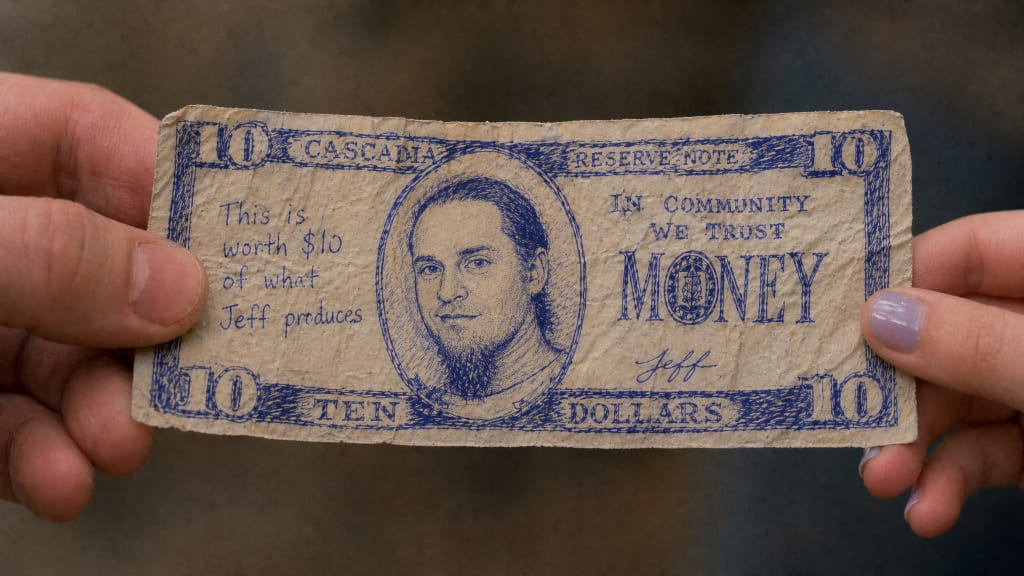
Universal Basic Income – scaling up our already grandiose welfare state to be completely ubiquitous – will not be necessary.
As a student of history and economics, my gut reaction to UBI has been to angrily point, shout “commie”, and consider my duty fulfilled. But as this topic lingers, I have finally decided to take some deep breaths and explain.
Then I realized what I’m about to share I didn’t learn in a normal economics class. I’ve taken several university econ courses, even a sustainability-focused upper-level economics class, but none of them covered the Local Wealth Multiplier Effect.
Therefore, I’m sorry if I shouted at you, and I’m ready to explain what the welfare-state education bureaucrats would not teach us.
Of all places, I learned this economic lesson at a Permaculture Design class. One thinks of Permaculture as a landscape design thing, but it goes wide and deep.
One day, a guest speaker at Delvin Solkinson and Kym Chi’s Permaculture course, Bruce Vernier, explained money and wealth with a clarity I had never heard before, and hardly since.
He taught us about the 8 forms of capital, only one of which is financial. We learned how to leverage any form of wealth we have into forms of wealth we don’t have. The most familiar example is turning intellectual capital, like your degree, into financial capital.
We also learned how a little money can make a community rich when the money stays local.
How to get rich with one fake $10 bill
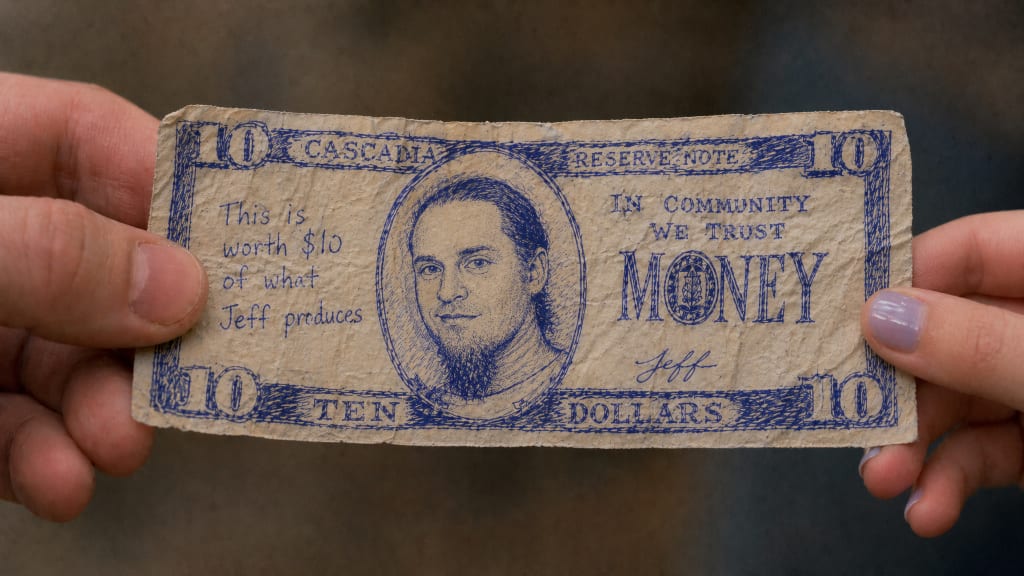
Picture a group of neighbors. Each one grows or makes something the others want: bread, vegetables, eggs, clothing, etc.
But nobody has any money. So one neighbor takes a piece of paper and writes on it: “This is worth $10 of what I produce.” He trades this IOU to his neighbor for $10 worth of eggs. That neighbor then trades the same paper to someone else for $10 worth of bread.
Each time the paper changes hands, someone gets something they want. Eventually the paper comes back to the original maker, and he honors it by handing over $10 worth of whatever he makes. If he has $10 of extra production ready, the paper can keep circulating.
As long as everyone keeps spending the $10 whenever they receive it, and as long as everyone is roughly equally productive, that single “fake“ bill lets the entire neighborhood enjoy as much of each other’s goods as they want.
That is the Local Wealth Multiplier Effect. As long as it’s backed by real goods & honest people, they can make more money to trade amongst themselves.
The Wealth Leak Effect
Right now we do the exact opposite. Most of the money we spend leaves our community the moment we pay.
Buy something at a big-box store and only a small fraction stays with the local employees. The rest disappears to distant factories, corporate headquarters, foreign suppliers, and investors who live elsewhere.
Order from Amazon and none of it stays. That dollar is gone, and with it goes the opportunity for that money to circulate locally.
The only way to get that dollar back into the community is to go work for Amazon or the big-box store and import it again — only to watch it get exported right back out on your next purchase.
Why Are We Like This?
Our world is built this way due to the centralizing logic of the industrial age. The globalized economy came about due to 2 forces:
-
Expensive automation, which must serve a mass market to be profitable
-
Cheap labor, often found far from the end customer
These forces are so economically powerful, they overcome the cost of shipping products from the other side of the planet, tariffs, storage, middlemen, and mass marketing campaigns, to still turn a profit.
But both of those forces will be largely nullified by AI and robotics. Intelligent automation will replace factory automation and the cheap laborers.
Then everything changes.
It will make no economic sense to ship mass-produced stuff across oceans if a local robot artisan can custom-make something preferable, in the customer’s community.
On one side, producing near the customer becomes more profitable because it cuts out costs. On the other side, customers receive bespoke goods with service that can only be provided locally.
Then the Local Wealth Multiplier Effect kicks in and we can all have a good laugh about that zany UBI idea we once had.
Jumping Ship
If you’re turning the gears of a global conglomerate, there is a good chance you will lose your job.
But the opportunities that open up will be abundant. AI is intellectual capital available for everyone. When the robots hit the market, we will be able to download experiential capital into them, like the skills of a master craftsman. We will then be able to leverage intellectual and experiential capital, into financial capital.
Anyone will be able to do similar work via their robot and basic artisan tools. Locally made goods will offer the best prices because they will not need to include the cost of shipping, tariffs, or corporate bonuses.
Small artisan businesses will beat the corporate giants on service and customization when dirt-cheap skilled robot labor makes their products price-competitive.
There will be a massive boom to local economies as this shift happens. Goods and services that were not economically viable will all of a sudden be wildly profitable.
3D Printing For Everything
The closest parallel is 3D printed goods. My wife has discovered Bambu Lab Studio and now I often find her perusing new items like she would Amazon. Now she has a collection of 3D printed earrings hanging from a 3D printed earring shelf on our wall. They are genuinely cute. Our kitchen is full of clips, holders, guides, measures, and gizmos she has 3D printed.
Her logic is simple. Why would you drive to a store and pay $8 for something you can download for free and print at home for 80¢ of material?
That is the logic that will drive the new economy.
Soon, anything handmade and all artisan crafted goods will be like 3D printing something. You give a robot the material it needs, you download a design, and it makes you pants. Or shoes. Or dinner. Or a guitar.
You’ll still need specialized tools beyond the robot, so there will still be plenty of economic variation & demand. Your robot won’t be making you a guitar unless it has an ibex finger planer, a go-bar deck, and a dragon rasp. But if you want to become the community guitar maker, the barrier to entry will be lower than ever.
Free-market capitalism will flourish locally like never before. People who create value for their neighbors will be the new rich in a cycle that will distribute wealth to their whole community.
Money will circulate locally, instead of leaking out. Every spending cycle will spread more wealth.
Communities will experience real prosperity without the federal government sending them checks. With enough abundance in a high-trust community, a “just economy” will likely arise with local business owners helping locals in need directly, and therefore cut out the bureaucratic cost of welfare.
This is our fate when these technologies of efficiency take hold.
We will not need UBI. We will have an economy that causes the Local Wealth Multiplier Effect take hold. And that economy is arriving soon with AI robotics.