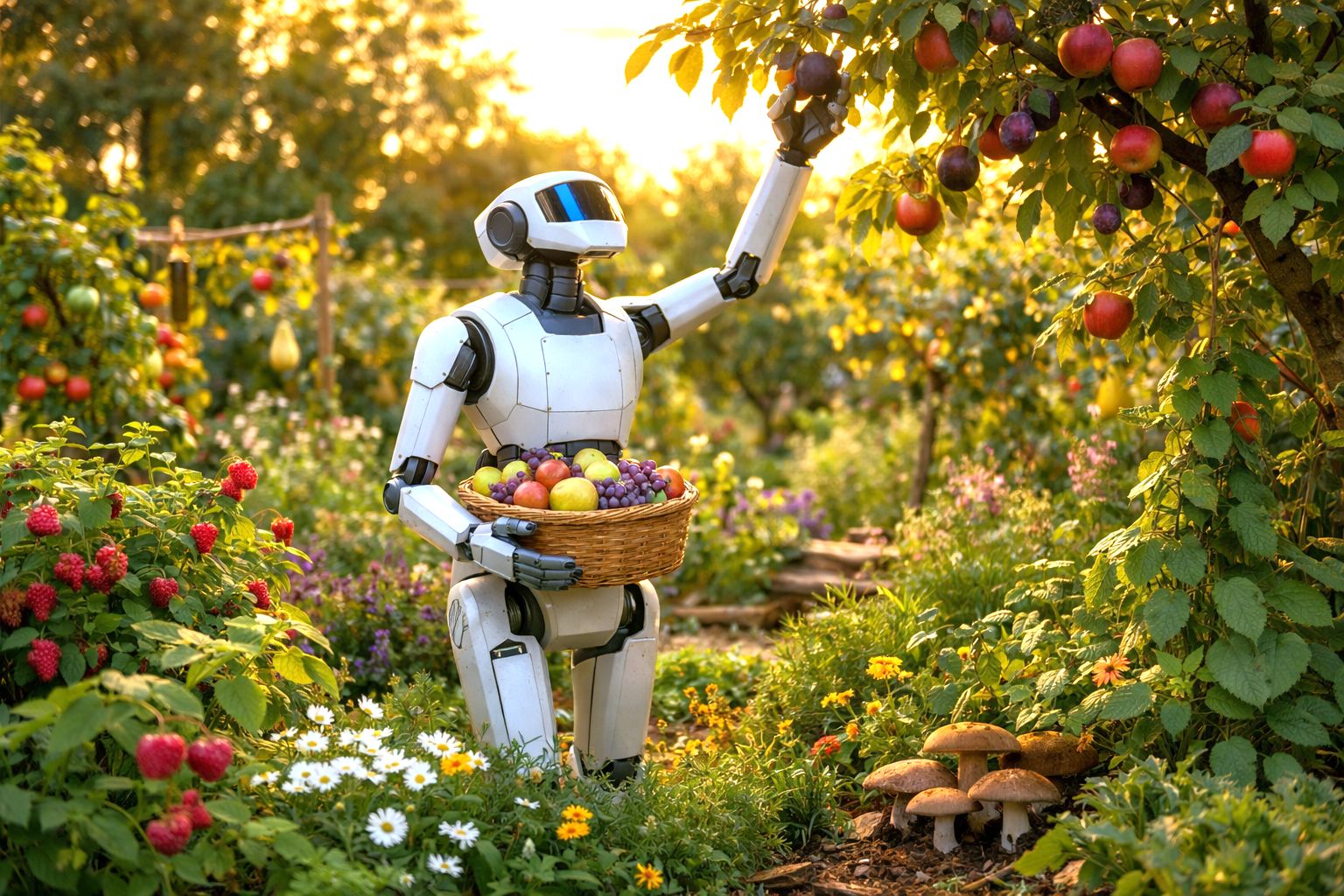
Permaculture offers a form of agriculture that works with nature instead of against it, giving us a path to a sustainable future. It describes how diverse, food-producing plant communities can be designed to be self-sustaining, requiring zero human inputs, to create a harvest-only agriculture system.
The only problem is, we don't have the machines to automate permaculture. We've spent a century developing industrial automation for monoculture farming. But diverse perennial systems have had no equivalent automation stack.
As long as permaculture requires human hands to plant, pick, and process food, tractor-powered monoculture will be the norm.
But the technology to automate permaculture is beginning to bear fruit. When we layer in AI, knowledge databases, and robotics, the economics of permaculture will shift.
The Learning Curve
The first thing I realized when I learned about permaculture in 2008 is the scope. It draws from all applicable academic fields and demands your attention to dozens of concerns. There are too many variables to call it science and it's too technical to be art.
I read Mollison's Permaculture Design Manual cover to cover, fascinated by all the meta-considerations. Zones, sectors, microclimates, stacking functions, maximizing edges, succession planning, layered polycultures, and earthworks. Design for efficiency, for all the seasons, design for yield, for comfort, for disaster, for the birds, for the bugs, for the future, for resilience, and especially design for food. Curiously, no gardening instructions.
Our minds don't manage this amount of priorities well. Reading about permaculture felt more like absorbing a natural philosophy intuitively: holistic beyond practicality.
When I finally found myself at my first permaculture homestead, I was shocked by how unprepared I was.
I could hardly tell a strawberry from a weed. I had this high-level homestead design perspective, but I hadn't gotten the how-to-garden book yet.
The master gardener, who saw the thick Designer's Manual among my few WWOOFer possessions, encouragingly suggested I use my own judgment for what needed to be done in the garden. But she still had to explain every little detail to me.
To make matters worse, I'd ask high-level design questions, assuming I was missing something.
Me: Why didn't you put your veggie garden in the sunny spot outside your kitchen where there's nothing now?
Her: Well, we had all that space there. (pointing 50 yards from the house)
Me: Why didn't you set up the animals at the top of the hill, so we're not fighting gravity to get manure to the compost pile?
Her: Yeah, we realized we need to move them, but it's hard once you're established.
Despite both of us having passionately studied permaculture, neither of us had all the right answers. They were focused on practical needs like companion planting, solar-hot water, and composting toilets, while skipping broader design principles. I was focused on the abstract design side while overlooking more practical considerations.
The point is, permaculture has a real knowledge problem: it asks people to manage ecological complexity that exceeds what most individuals can reliably hold in their heads.
To compound the issue further, what's true about one climate isn't true about another. What works in the soil here might not work in the soil there. Not only is permaculture vast and complex, its details are also regional.
Intelligence vs Brute Force
Big Ag overcomes this problem by forcing the land into uniformity with pesticides and fertilizers, then planting one industrialized species at a time. It feeds us, but the inputs are massive, toxic, and several key inputs depend on finite resources that carry significant environmental costs.
While industrial agriculture solves problems with brute force, permaculture solves problems with brute intelligence.
Permaculture depends on reading the land correctly and working with nature, not forcing its compliance. Instead of just buying the equipment and following steps, you must analyze and understand the forces of nature to use them to your advantage.
To succeed in creating a productive, self-sustaining plant community, one needs a level of knowledge and focus that is impractical to expect from most people. The people most equipped to handle this complexity are often pulled toward work that pays better than stewarding a complex food system.
The kind of intelligence required to plan and implement a permaculture project has been in short supply, until AI came online.
Hi-Tech Permaculture
My first prompt to an AI was about designing a food forest for my climate. It spat out a plan that was missing a few layers, and many of its recommended species would not have lasted the winter.
Then I learned about retrieval augmented generation (RAG) and knowledge graphs, which I've started thinking of as permaculture tools. They are fancy databases.
Essentially, you can stop an AI from hallucinating by connecting it to the proper information. It's the difference between asking someone if they remember something versus asking them to look it up.
The many volumes of data permaculture has produced can be quickly traversed when they're ingested into these databases. Then the AI has the accurate references it needs in order to formulate the correct response.
Permaculture might be horribly complicated for a human mind, but if you could scan 10,000 pages in a few seconds like an AI system can, permaculture wouldn't seem so esoteric.
Add a bit more technology to the mix, and we can set up an automated mapping and planning system.
There are AI models that can see if you give them a camera. Fine-tuning them for something like leaf identification is easier than learning all the leaves yourself.
Mix servos, sensors, and open source software in, and we can set up a robot to autonomously gather data about your site. Industry-standard robot mapping software is already free. We could tailor it to permaculture needs, connect it to a repository of permaculture knowledge, and have technology do the planning for us.
The Harvesting Problem
Embarrassingly, despite 18 years of interest and multiple permaculture credentials, I've only recently realized the real bottleneck to the permaculture approach. I've been focused on the planning, implementation, and eventually plant-care aspects of permaculture.
But the real problem with permaculture is the harvest.
I had clues.
- Growing up we had a plum tree that my parents cut down because it was "too messy."
- I see a lot of fruit trees around town that never get harvested above average reach.
- The main reason our home garden pays off is that my wife has magical kitchen powers.
- At that first permaculture homestead, they told me that when they harvested their olive trees they had to rent equipment, it was labor-intensive, and didn't get nearly as much oil as they had hoped. They weren't harvesting the olives that year because buying olive oil was cheap and easy.
These clues pointed at a reality I overlooked all those years: the most difficult part of producing food is keeping it from going to waste. Harvesting by hand is not efficient and preserving food is labor-intensive. That's why cottage-industry jam is always ungodly expensive.
The biggest bottleneck is not design. It is harvest. A diverse food system does not produce one synchronized industrial crop. It produces a long stream of different harvests, each with its own timing, handling, preservation, and processing requirements.
If you grow a field of just one crop, like Big Ag does, then you can build a tractor that harvests the field in bulk. If you harvest in bulk, it's economical to automate the processing with industrial equipment.
The thing is, industrial machines do one task at a time with a narrow range of variation. Plus, they're expensive. Therefore, industrial automation simply doesn't work for a farm growing 50 crops.
The Dream Goes Moldy
Imagine you've meticulously planned a permaculture garden, installed it, nurtured it through its delicate years, and watched it mature over a decade. You have nut trees above fruit trees, with vines growing above the berries, above the herbs and veggies, with hidden mushrooms and tubers, and flowers scattered about. You've created a balanced ecosystem where the symphony of plants provides all the ecological functions required for nature to thrive on its own. It's all wonderful except for one thing.
You'll need to harvest and preserve a whole lot of food soon or it will go bad.
You might have specialized hand tools for processing different types of crops, but you can't afford industrialized equipment for dozens of different smaller harvests. These tools require more effort and skill to use than their industrial counterparts.
And of course, you'll be picking everything by hand.
Diverse perennial systems do not ripen all at once. You do not have a berry harvest; you have months of harvesting berries and doing something with them before they go moldy. At any given time, there could be dozens of different crops that need to be harvested, and there's only so much you can eat before it goes bad.
Therefore, this horticultural miracle you've created is actually a full-time job harvesting and preserving food. Even if your food forest is completely self-sustaining and all you do is harvest, you're going to be working nonstop in peak season or letting food go to waste.
Plus, you have to find a way to sell $12 jars of jam.
Until we automate the harvesting and processing of diverse, multi-layered gardens, permaculture will remain impractical.
Automation Will Save Permaculture
Permaculture has been around for 50 years, courses are taught around the world, and countless gardens have been inspired by permaculture. I'm thrilled to see many yards in my town bursting with fruit.
But it often looks like the birds eat more of it than the people. There are lots of those "messy" plum trees and fallen fruit because harvesting and processing it is a lot of work.
This is why robots are so essential to permaculture. When we replace dumb industrial machines that can only do one thing with AI-empowered robots, which have begun being mass produced, permaculture will finally have the automation tools it needs to become practical. If they can already do kung fu, they'll definitely be able to help me pick fruit, juice it, and make fruit roll-ups with the pulp.
Demonstrations have shown that a permaculture approach can create just as many edible calories per acre as the best industrial crops, while also:
- Using zero pesticides, herbicides, or chemical fertilizers
- Creating welcoming spaces for people
- Encouraging local ecology
- Increasing topsoil
- Sequestering carbon
- Delivering a complete diet from a single farm
Permaculture has had the design theory for decades. What it has lacked is the tools to automate the system. Industrial agriculture scaled because it mechanized uniformity. Permaculture will scale only when we mechanize adaptability.
When we can buy a crew of robots for the price of a John Deere tractor, which will not only harvest but process food with hand tools, productive perennial, low-input polycultures will become the new standard.