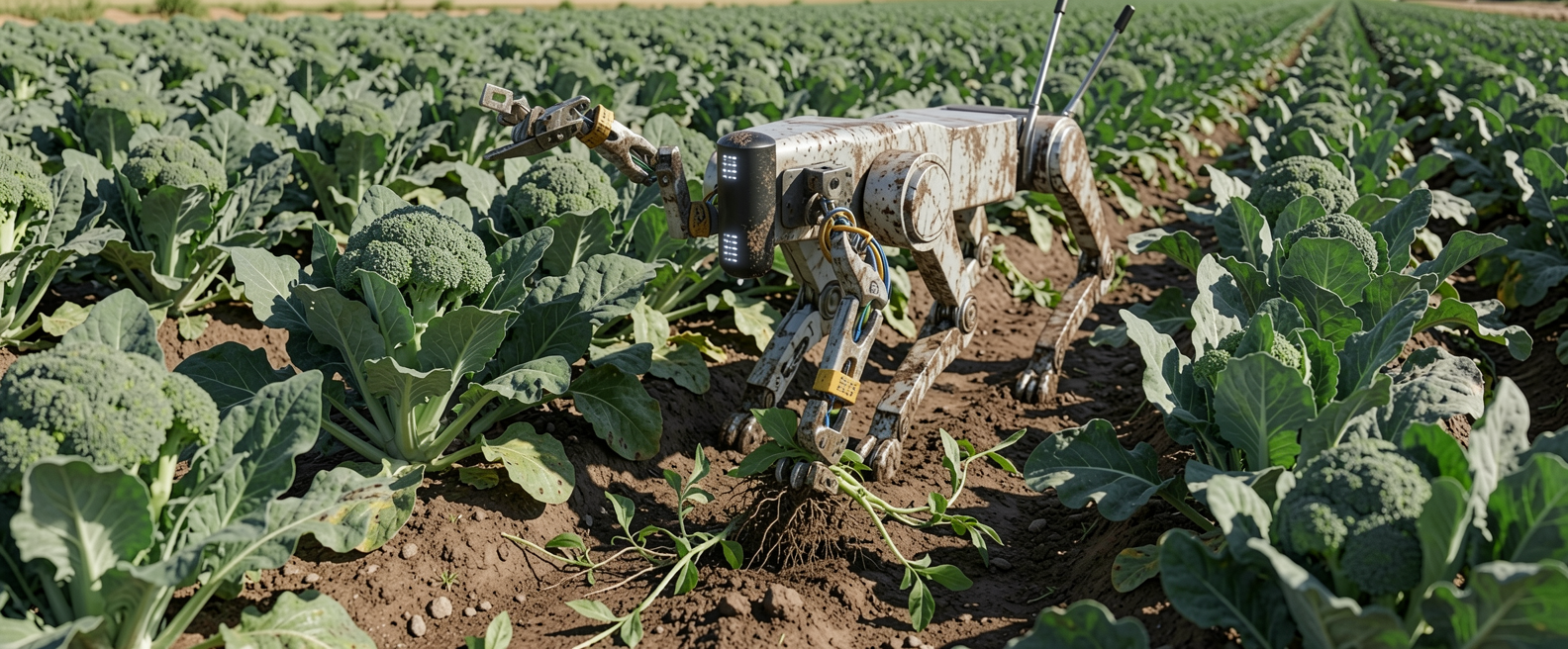
We now have the technology to dramatically reduce the price of organic food. Here's how.
Much of the premium you pay for organic produce is because of weeds. We choose organic to avoid the toxic residues from herbicides, but the farmers still need to stop the undesirable plants from choking out their crops.
Weeding organic brassicas and direct seeded crops can cost well over $1000/acre, as critical passes must be done by hand. It's labor intensive work, where you can often find undocumented immigrants being paid far below minimum wage.
But now we have mature plant identification technology and precise guidance systems that can run on inexpensive hardware. We have affordable robotics that can zap, snip, or fry weeds, row after row, without anyone bent over in the sun all day.
The total cost of growing organic broccoli, onions, or carrots is between $7k to $10k per acre. Weeding pressure varies widely between crops and seasons, but expensive hand weeding is required for many organic fields.
Broccoli farmers expect to pay up to $1,000 per acre for hand weeding, while onion farmers expect to pay at least that much, but often double.
Carrot farmers regularly pay the most for weeding. Up to 35% of their costs go to laborers crawling through their fields, on their hands & knees, pulling weeds.
A precise AI empowered weeding platform would provide immediate savings to organic farmers, who could pass that along to the customer.
Although, weeding is not typically the primary farming cost. For many crops, whether they're organic or conventional, the largest farming expense is the harvest.
Strawberries, zucchini, cabbage, tomatoes, cucumbers, peppers, and many others are hand picked. Over 50% of the cost of farming these crops is to pay for the harvest.
Produce like zucchini and peppers are too delicate to be harvested with industrial machines. Plants like strawberries and tomatoes will have both ripe and immature fruit at the same time, so the picker must select only what is ready for harvest.
Industrial farming equipment doesn't do soft hands and discerning eyes. So people are tasked with working long hours in the Sun doing the repetitive work of picking produce by hand.
But now a delicate grip can be automated. We can build machines that recognize if a strawberry is ripe and pluck it without crushing it.
If we can efficiently automate weeding, harvesting, & planting these crops, we offset the majority of the farmers costs.
The only problem is, our real goal is dramatic reduction in the price of organic food. Even if we reduce the farmers' costs by 70%, the customer will only see a fraction of that cost reduction.
When you buy a head of broccoli at the store, you're paying for transportation, refrigeration, logistics, packing, spoilage, the stores overhead, and the farmer.
The percentage that goes to the farmer varies greatly. Around 40% of the price of broccoli ends up in the farmer's account.
Carrot farmers get one of the largest cuts. Carrots have a long shelf life and don't need much processing. If an affordable robot was doing the carrot planting, weeding, and harvesting, we might see a 40% drop in carrot prices.
But if a broccoli farmer had the same cost reduction, we might only see a 25% price drop.
The real economic magic will happen if you can automate these tasks with relatively inexpensive technology.
AI directed laser weeding systems already exist. You can pick one up from Carbon Robotics for $1.2 million. Other companies are offering AI integrated snipping and zapping equipment for the bargain price of $250,000. But if it's going to cost you $100,000 to weed 100 acres, that price looks reasonable.
And here's where a reasonably priced agriculture platform shifts the incentives.
Industrial equipment only makes sense if you have a huge farm. You can rent this equipment, but only in areas with other huge farms that have this equipment to rent to you.
These farming areas are typically far away from the stores that will be selling their produce. The farmer doesn't have a relationship with the store, but with a distributor (middleman) who arranges the pickup and shipping to the store. The farmer is busy on his huge farm so he'll probably outsource any prep & packaging that's needed.
And that's how industrial tractors result in farmers taking such a small cut of the sale, while putting them in debt. With the dubious distinction of being both capital-intensive and low-margin, it's no surprise that so few people are signing up to be farmers.
But if your farming equipment isn't as wide as a highway and doesn't cost as much as a private jet, the constraints shift, along with your needs and relationships. SPIN (small pot intensive) farmers like Curtis Stone & Jean-Martin Fontier demonstrate this effect.
Instead of using large & expensive equipment, they use affordable walk-behind BCS tractors and hand tools. This allows them to farm in urban areas where they can maintain relationships with their customers and skip the middleman.
The equipment shapes the farm. Large tractors require farmers to plant in single file rows 40 inches apart. SPIN farming equipment is designed for densely planted beds, starting every 40 inches and running 30ft+, allowing them to grow up to 8 times more produce on an acre than traditional farmers.
Spin farmers regularly net north of $50k on an acre or less. They've been known to set up on vacant urban lots and borrowed yards, delivering their produce directly to local restaurants, on bike.
The spin farmers' costs are minimized while capturing the full price of their produce.
That's the farming model we need to expand. Fresh, locally grown produce, supporting a circular economy.
If we can create an affordable robotics platform that can automate most of the 8 steps of spin farming, we can flip the script on agriculture.
Farming would become a lucrative career path you do in an urban environment. It would have a low cost of entry and be a relatively easy job, which you could easily pivot away from later. Much of the job would be delivering fresh food to happy customers, instead of never seeing your customers and being stuck out on a country farm.
When farming becomes that local and that effortlessly, then the price of organic produce will dramatically drop.